VGG is a deep learning-based Convolutional Neural Network (CNN) model developed by the Visual Geometry Group (VGG) at the University of Oxford in 2014.
It was introduced in the paper "Very Deep Convolutional Networks for Large-Scale Image Recognition" and achieved high performance in the ImageNet Challenge 2014 (ILSVRC 2014), making it widely known.
📄 Paper Link: [VGG Paper (PDF)](https://arxiv.org/pdf/1409.1556)
---
1️⃣ Key Concept of VGG
VGG improves CNN performance by stacking more layers (16–19 layers) to make the network deeper.
🔹 Main Features of VGG
✅ Uses multiple small 3×3 filters instead of larger filters
✅ Consistent network structure (3×3 convolution + 2×2 max pooling)
✅ Deeper network structure (16 or 19 layers, VGG-16 / VGG-19)
✅ Achieved outstanding performance on the ImageNet dataset
---
2️⃣ VGG Network Structure
VGG stacks multiple 3×3 convolution filters and applies 2×2 max pooling to extract features.
🔹 Example: VGG-16 Architecture
1. Input: 224×224 RGB image
2. Convolution (Conv): 3×3 filters
3. Max Pooling: 2×2 pooling
4. Fully Connected Layers (FC): 3 layers
5. Output: Softmax activation function for 1000-class classification
🖼 VGG-16 Layer Configuration
| Layer | Filter Size | Output Size |
|---|---|---|
| Conv1 | 3×3 | 224×224×64 |
| Conv2 | 3×3 | 224×224×64 |
| MaxPool | 2×2 | 112×112×64 |
| Conv3 | 3×3 | 112×112×128 |
| Conv4 | 3×3 | 112×112×128 |
| MaxPool | 2×2 | 56×56×128 |
| ... | ... | ... |
| Fully Connected (FC1) | - | 4096 |
| Fully Connected (FC2) | - | 4096 |
| Fully Connected (FC3) | - | 1000 (Softmax) |
---
3️⃣ Advantages of VGG
✔ Consistent structure: Repeated use of 3×3 convolution filters makes it simple yet powerful
✔ High accuracy: Achieved great performance on ImageNet
✔ Pre-trained model available: Useful for transfer learning
---
4️⃣ Disadvantages of VGG
❌ High computational cost: Deep networks require a lot of computation and memory (RAM/GPU)
❌ Slow processing: Using multiple 3×3 filters increases computational cost, slowing down training and inference
❌ Overfitting risk: Deep architectures can lead to overfitting on small datasets
---
5️⃣ Applications of VGG
VGG is widely used in various computer vision tasks:
🔹 Image classification
🔹 Object detection (e.g., YOLO, Faster R-CNN)
🔹 Face recognition
🔹 Medical image analysis
🔹 Neural style transfer
---
✅ Conclusion
VGG significantly improved CNN performance by making networks deeper and introduced a simpler and more structured architecture.
However, due to its high computational cost, newer architectures like ResNet and EfficientNet have largely replaced it in modern applications. 🚀
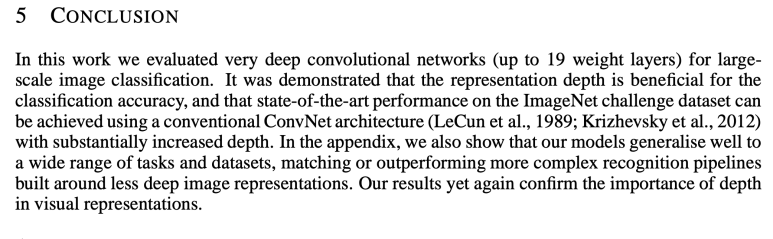
VGGNet is an architecture designed to verify how increasing network depth affects performance. The conclusion of the paper explicitly states that it demonstrates the importance of depth in vision tasks.
The convolution filters are fixed at 3×3 to focus solely on the effect of depth. If the kernel size were larger, the image size would shrink more rapidly, making it difficult to construct a deep network.
At that time, VGGNet achieved remarkable performance in terms of low error rates, proving to be highly competitive.